
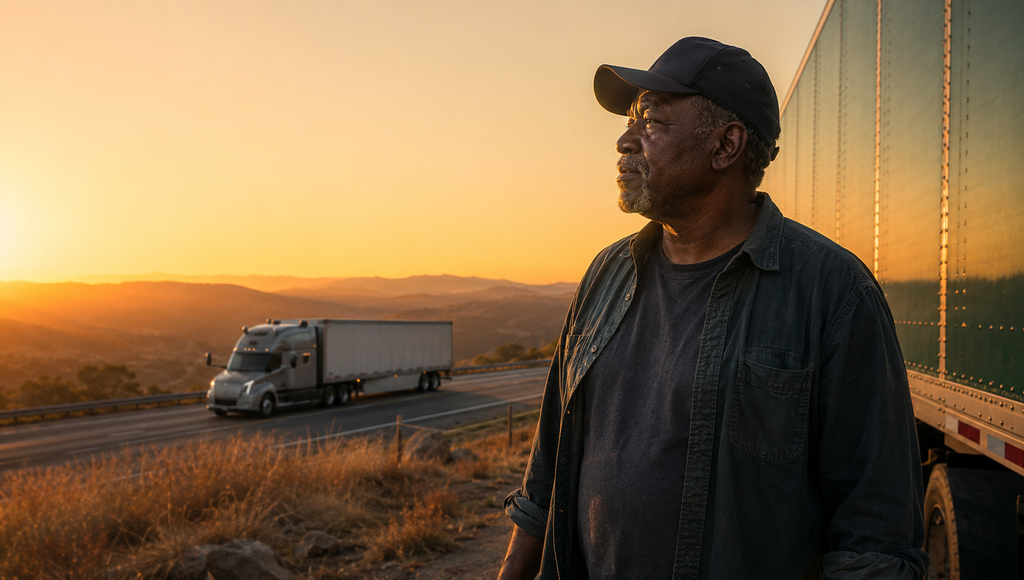
A shipper put it to us straight a couple weeks back. Rates are up, capacity is tight, and he had read somewhere that self-driving trucks are hauling real freight now, so he wanted to know whether he should just ride the tight market out a little longer and let the robot trucks bail everybody out. It is a reasonable thing to wonder, and a lot of freight buyers are quietly hoping the same thing right now.
The honest answer has two parts that do not cancel each other out. Driverless trucks really are on the road, hauling paying freight, and they got there faster than most of the skeptics figured they would. They are also not going to do a single thing for your capacity or your rates in the next few years. Anybody planning around that rescue is going to be standing around waiting while the actual bill for this market keeps coming due.
Let me give the technology its due first, because the progress is genuine. Then I will show you why it does nothing about the problem sitting on your desk this year.
They Are Real Now, and That Catches People Off Guard
If your mental picture of self-driving trucks is a tech demo creeping around a closed course, that picture is out of date. This is running on open public highways, with real freight, and nobody in the seat.
Aurora has driverless trucks moving freight across a handful of Sun Belt routes and has piled up hundreds of thousands of miles with the driver's seat empty, and they are talking about a few hundred trucks on the road by the end of the year. Gatik has been running fully driverless middle-mile deliveries for Walmart, tens of thousands of them, with real money behind the contracts. Out in the Permian Basin oilfields, Kodiak is running the biggest fleet of driverless heavy trucks anywhere and is aiming at real long-haul highway freight in the back half of this year. None of that is a slide deck or a someday promise. The technology crossed over into actual paying freight, and the folks who spent a decade swearing it never would are pretty quiet lately.
So I am not going to sit here and tell you it is fake or that it is thirty years off, because both of those would be lies. The thing worth understanding is that a technology can be completely real and still be useless to you, and that gap is exactly where a lot of shippers are about to have their hopes handed back to them.
Now Look at the Scale
Start with the number that quietly ends the daydream. Something like four million heavy trucks are working the roads in this country on any given day.
Set the entire driverless fleet next to that. Today it runs in the dozens, and the ambitious plans have it reaching maybe a few hundred trucks by year's end. Four million against a few hundred is not a dent. It is a rounding error you would need a magnifying glass to find on the chart. Say these companies double or triple their fleets next year and a couple more scale up behind them, and you are still looking at a sliver of one percent of the trucks that move this country's freight.
That gap does not close quickly, either, because going from hundreds of trucks to a number big enough to swing a national market means years of building and validating and manufacturing and clearing regulators one corridor at a time. The forecasts that get everybody excited, the ones with the giant autonomous market, are pointing somewhere out in the 2030s. They are not pointing at your fourth quarter. So when a headline tells you autonomous freight has arrived, believe it, and then remember it arrived at a size that could not loosen the capacity you are scrapping for this year if it tried.
The Part It Cannot Do Is Most of the Job
Set the scale problem aside for a second, because there is a deeper reason this does not touch your capacity pain. The trucks only do the simple slice of the work.
Every one of these driverless operations runs the same shape. The truck handles the long, dull highway stretch in the middle, and people handle everything on both ends of it. Somebody human still does the pickup and the drop, the city driving, the backing into a cramped dock, the routes with eight stops, the hazmat, the sitting and waiting at a shipper's gate for three hours. What drives itself is the freeway cruise between two points that sit right off the interstate.
And the parts a person still has to do are most of what freight actually is. A huge share of trucking is not one tidy highway shot between two hubs. It is dock after dock, stop after stop, customer sites and tight city streets and all the fiddly human work the technology cannot touch and will not be able to touch for a long stretch yet. Which means even in some future world stuffed with driverless trucks, you would still need people behind the wheel for the bulk of what moves your freight. Nobody is replacing the driver here. For now, at the very most, a computer is handling the easiest hours of the easiest lanes.
Wherever It Is Running, It Is Probably Not Where You Ship
Here is the piece that makes it personal. Even the driverless freight that does exist almost certainly is not running on the lanes your freight runs on.
These operations cluster on a short list of corridors, mostly across Texas and Arizona and a few other warm-weather routes, picked on purpose for clear skies, straight highways, and agreeable rules. Good strategy for them. Cold comfort for you if your product moves through Chicago in February, or up the East Coast, or basically anywhere that is not one of a dozen hand-selected sunbelt lanes. Whatever relief this creates is landing on a few specific highways in a few warm states, nowhere near the sprawling national network your routing guide actually lives on.
Add the whole thing up and you get the honest shape of autonomous freight right now. A tiny fleet, doing only the easy highway middle, on a few southern lanes that most likely are not yours. Impressive as an achievement. Just about beside the point for the capacity problem you are trying to solve before the year is out.
What Actually Fixes Your Capacity Now
So if the robots are not coming to save the quarter, what do you do about a market that is tight and expensive and here today? You handle it the way this has always genuinely gotten handled, through people and the relationships you have with them, not through a rescue that lives somewhere out past the horizon.
The capacity that moves your freight this year is human capacity, and human capacity flows toward the shippers who earn it. There are not enough carriers with a truck and a driver ready, so those carriers get to pick, and they pick the shippers who are easy on them. The ones who load and unload fast, who pay fair and pay on time, who do not come back every quarter trying to grind another nickel out of the rate. In a tight market that is not a nice-to-have. It is the entire ballgame, and the shipper who has built those relationships gets the truck while the one holding out for a technological miracle gets whatever capacity is left over at whatever rate is left over.
This is the spot where a broker who genuinely knows carriers pays for himself, and I will be blunt about it. There is no fleet of robot trucks for us to sell you, and there is not one for anybody else who is being honest about the calendar. What sits behind our name is a set of relationships with real carriers who actually show up, built over a lot of years, plus the vetting to know which ones are worth putting under your freight. When trucks get scarce, that network is what covers you. An algorithm cruising a highway in Arizona does not.
You can watch the difference play out in any tight week. A shipper who spent the soft years beating every carrier down to the floor finds nobody in a hurry to help once trucks dry up, and the loads sit or spill to the spot market at the painful rate. A shipper who treated the carriers like partners, kept them loaded, paid them square, handed them steady freight, that one still gets a truck when there is barely a truck to be had. Technology has nothing to do with it. It comes down to who owes you a good turn when the market flips, and good turns get built in the fat months, not begged for in the lean ones.
So build your plan around the market you are genuinely in. Get the carrier relationships solid, make your freight the freight people want to haul, and file autonomy under things that might add a little capacity on a few lanes somewhere down the road, not under reasons to wait out a crunch that is bleeding you right now.
The Bottom Line
Driverless trucks are real, the progress is honestly impressive, and none of it changes your capacity problem this year. The fleet barely registers against the millions of trucks out there, it only takes the easy highway stretch while leaving the dock-and-city work to people, and it runs on a few southern corridors that probably skip your lanes entirely. Anybody telling a shipper to sit tight and let automation fix the rates is handing you a comfortable story the arithmetic will not back up.
Your market is tight, it is human, and it pays off the shippers who put real work into their carrier relationships instead of waiting on a machine. That is not the thrilling answer. It is the one that actually gets your freight moved this year, and the year after, and every year until the trucks that drive themselves grow into something more than a sliver of the ones on the road. We would a whole lot rather help you win the market that is here than help you wait on the one that is not.
Want reliable capacity in the market you are actually shipping in? Let's build it the way that works, with real carriers and real relationships.
📞 (931) 200-5601 | nfc@nationalfreightconnection.com
This one drew on 2026 reporting from Transport Topics, Heavy Duty Trucking, and ACT News on where driverless freight actually stands, including Aurora's Sun Belt route expansion and mileage, Gatik's driverless middle-mile work for Walmart, and Kodiak's Permian Basin fleet and long-haul plans. The reality check on scale against the roughly four million heavy trucks on U.S. roads, the limitation that leaves first-mile, last-mile, urban, and dock work to human drivers, and the longer market-growth horizon drew on O Trucking's driver shortage analysis and fleet-management coverage from industry technology outlets, with driver shortage figures from the American Trucking Associations by way of PLS Logistics.