
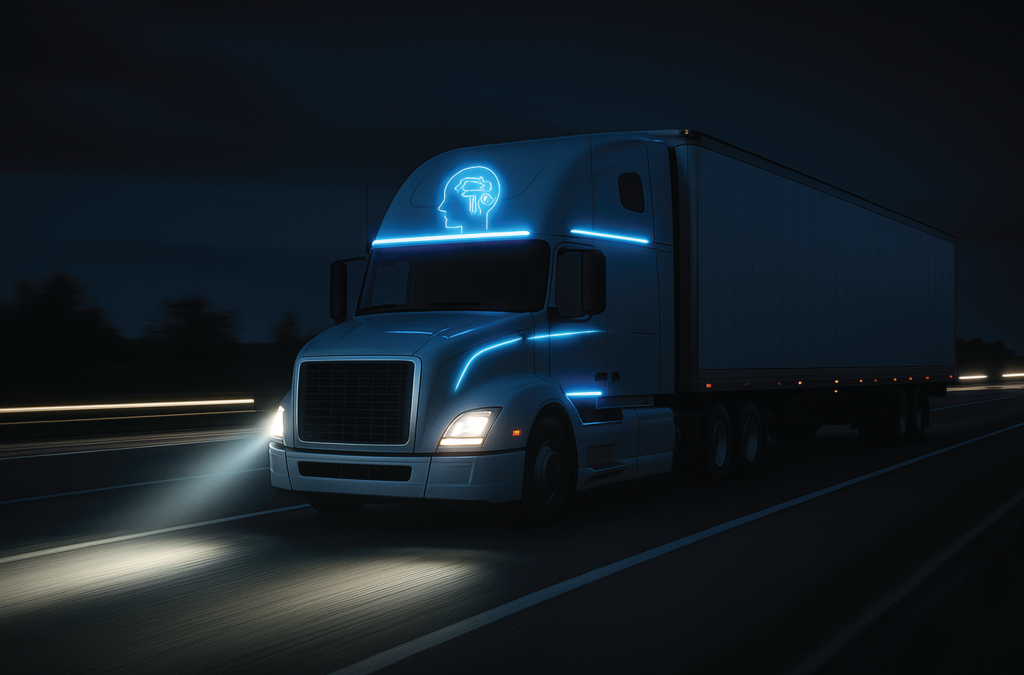
At its inception, many questioned the practicality of self-driving trucks or “driverless” freight. Questions revolved around the safety of these trucks operating on public roads and how they would handle unpredictable variables. However, an announcement from an autonomous vehicle developer may indicate that self-driving trucks are no longer just a beta-phase prototype. They are entering the mainframe with one caveat, they only drive at night.
Technology developer, Aurora Innovation, announced that its self-driving technology has been put to task in a fleet of 100% driverless Class 8 trucks. These trucks are carrying commercial freight along the Dallas-to-Houston corridor, and yes, they are doing it during nighttime.
The trucks are being controlled by “radar-like sensors that can see farther than headlights and machine-learning software that never blinks” and are running zero-miles-from-a-driver in the right-hand lane and at highway speeds.
Are we witnessing the inception of the future of freight, or will this technology stall like previous tests? Let’s find out.
⏳ What’s actually happening
1. 24-hour truck movement has arrived While autonomous trucks have had the capability to operate overnight, for testing purposes, Aurora Innovation’s “self-driving trucks have put a cover on Daylight Savings and are now moving freight through Texas on their own under the cover of darkness.” The trucks are now logging commercial miles and using LiDAR that detects and responds to objects at a range of up to 1,000 feet (compared to the approximate 500 feet that a human can).
2. Autonomous routes will expand Aurora will have additional driverless trucks running by the end of 2025, which will service the routes in Phoenix, Fort Worth, and El Paso, Texas. This means an expansion of miles and more middle-mile “lanes” will be using autonomy.
🔍 Why should the industry care?
Driverless trucks (or any autonomous solutions) will not be sitting idly by and will continue to collect productivity for a longer period of time. This means a boost in productivity per asset and a boost in potential return per truck.
Driver Hours-of-Service Regulations (HOS) are another point that can be removed by having zero humans in the cabin. Fatigue, inattention, and individual driving techniques are some examples of issues that automation can eliminate.
However, Aurora’s success may not mean that we will witness an explosion of driverless trucks. Variations in state regulations, performance under different weather conditions, and the lack of autonomous-specific infrastructure are examples of potential bottlenecks that could result in slow expansion rates across the country.
🚦 Strategic Takeaways
Think middle mile
Will autonomous freight replace every over-the-road route in the U.S.? Unlikely. However, it will significantly optimize the efficiency of long-haul lanes. For carriers and shippers that regularly move freight between terminals hundreds of miles apart, the use of autonomy can result in decreased cost and improved consistency.
Reallocate your drivers
If autonomous trucks become a standard for handling long-haul miles, then there is an opportunity to move drivers to regional and local routes. The result is the opportunity to cut fatigue and turnover while improving drivers’ job satisfaction.
Stay ahead of regulation
The federal government is still in the process of creating, finalizing, and solidifying rules and regulations around autonomy. Logistics and operations teams that have an understanding of where regulation is headed and can invest in pilots and early projects will have a competitive advantage.
Closing thought
The potential use and deployment of autonomy has major implications on the future of freight and beyond. Liability, labor, lane design, load dispatching, pickup and delivery, and freight transport are all affected.
While there are still gaps to solve, and weather conditions and scalability are still in question, there is a new development in autonomy, and it is one that will change the nature of trucking and how the industry is designed. Aurora Innovation’s all-nighter is just the beginning.
NFC will be closely following the development of the deployment of this technology and how this could work for our customers more efficiently and effectively. Reach out with questions and comments.
📩 Questions about how automation might impact your supply chain?
Let’s talk. (931) 200-5601 / NFC@nationalfreightconnection.com