
There's a regulatory change that has been unfolding in plain sight since June 2025, generating headlines, court cases, and executive orders, that most carrier compliance teams
have acknowledged without fully building into their workforce planning.
English language proficiency enforcement is real, it's active, and the capacity implications are
still being underestimated by a significant portion of the industry. This isn't a future risk to pencil
in for the next planning cycle. It's a present one that's already removed thousands of drivers
from the road, and it's building toward something larger as it intersects with parallel changes
to CDL licensing, training provider availability, and an aging driver workforce with a shrinking
replacement pipeline.
What Actually Changed and When
The federal requirement that commercial drivers be able to read and speak English sufficientlyto communicate with law enforcement, understand highway traffic signs, and complete required
records has been on the books since 1937. What changed is enforcement, specifically, what
happens when a driver can't meet that standard at a roadside inspection.
In 2016, FMCSA issued guidance telling inspectors to stand down on ELP, not to place
drivers out of service for proficiency violations. That changed in April 2025 when an executive
order reversed the guidance. Transportation Secretary Sean Duffy formalized it with an
enforcement directive in May, and by June 25, CVSA had added ELP noncompliance to the
North American Standard Out-of-Service Criteria under emergency provision, a process that
typically requires a full Class I member vote, accelerated here to meet the executive order's
60-day clock.
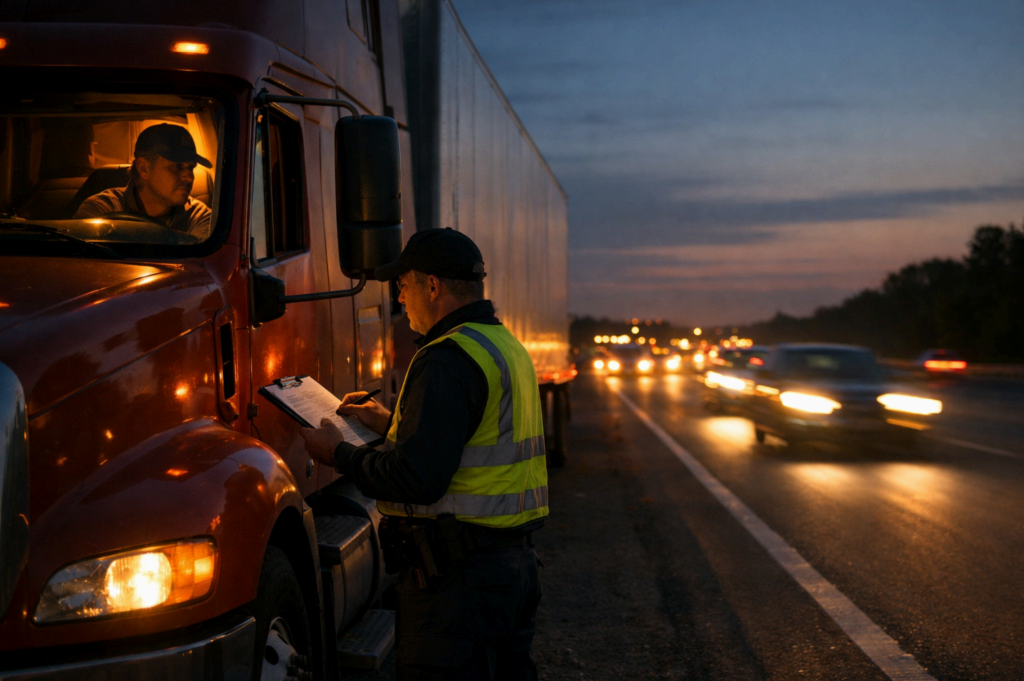
The practical result: a driver who can't demonstrate English proficiency at a roadside stop is
placed out of service on the spot. No warning. No accommodation, no interpreters, no
translation tools, the inspection begins in English and stays there. If the driver's initial
responses raise a flag, the inspector runs a two-step assessment: a conversational interview
first, then a highway sign recognition test. Fail either one and the driver is OOS.
Then in January 2026, the Consolidated Appropriations Act took it a step further and codified
the requirement into statute, meaning FMCSA now has to formally update its regulations to
treat ELP violations as OOS triggers. Whatever you think of the policy, the legal question is
settled. It's not guidance anymore. It can't be reversed by the next administration's priorities or a
new FMCSA administrator's interpretation. It's in the law.
What the Numbers Actually Show
FTR Transportation Intelligence has been tracking ELP enforcement data closely, and their
analysis is worth understanding carefully, partly because it's more calibrated than most of the
industry commentary, and partly because even the measured version of the story is significant.
Since enforcement began June 25, 2025, FMCSA recorded 12,308 OOS violations for
inadequate English proficiency through year-end, compared to just 14 total OOS violations
under the ELP requirement in all of 2023 and 2024 combined. That's not a rounding error.
Enforcement essentially didn't exist before June 25. Now it does.
Of those violations, roughly 28% resulted in formal OOS orders, about 6,500 drivers pulled
from service through the end of 2025. Project that forward from the August-September
enforcement peak and FTR's estimate lands around 25,000 drivers removed annually at the
current rate. The National Transportation Institute puts it more granularly: over 1,500 drivers
sidelined per month, on average, and counting.
The broader exposure is harder to quantify but worth sitting with. FreightWaves' Craig Fuller,
drawing on insurance industry data, estimated that as many as 10% of CDL holders may lack sufficient proficiency, which, across a 3.5 million driver workforce, represents a potential pool
of roughly 350,000 people.
FTR's Avery Vise has been measured about the near-term capacity impact, 25,000 driversannually is roughly 0.6% of the total driver population, meaningful but not by itself enough to
tighten the market. The word "by itself" is doing a lot of work in that sentence, though. ELP
enforcement doesn't operate in isolation. It's stacking on top of non-domiciled CDL restrictions
that are expected to affect 194,000 drivers over two years, on top of thousands of training
providers pulled from the FMCSA registry, on top of a structural driver shortage the freight
recession masked by suppressing demand rather than solving anything.
David Heller at the Truckload Carriers Association has been calling 2025 "the year of
enforcement", and the TCA, for the record, has been pushing for exactly this kind of
regulatory action for years. The combination of ELP, non-domiciled CDL restrictions, and
training provider enforcement is what Heller described to The Trucker as a "triple threat" to
driver supply. The capacity effects are welcome news for incumbent carriers running compliant
fleets. But fleets that haven't audited their own driver population are potentially the ones
absorbing the disruption rather than the ones benefiting from it.
The CSA Score Risk Most Carriers Haven't Modeled
Here's the dimension of ELP enforcement that gets the least attention in carrier planning
conversations: the CSA score exposure.
When a driver in your fleet is placed out of service for an ELP violation, that violation attaches to
your carrier's safety record. FreightWaves documented this specifically when enforcement
began, OOS violations for ELP noncompliance hit CSA scores directly, and where CSA
scores go, insurance premiums and shipper contract eligibility follow. A carrier who finds out at a
roadside stop, not in a compliance review, not during onboarding, but on the side of a
highway, that a driver doesn't meet ELP standards has already lost the day. The driver is
OOS, the truck doesn't move, and 24 months from now that violation is still on the company's
safety record.
Operation SafeDRIVE in January 2026 is worth looking at closely. Twenty-six states,
Washington D.C., 8,215 inspections, and 704 drivers placed OOS, roughly 500 of them for
ELP specifically. That's one operation, one month. Not a pilot. Not an outlier. Those violations
are sitting in carrier safety records right now.
The operational fallout goes well beyond the CSA entry. A driver placed OOS means the truck
doesn't move, someone has to dispatch out to retrieve the equipment, find coverage for the
load, and explain the service failure to whoever was expecting that freight to arrive. One
roadside stop becomes a cascade: service failure, detention event, safety record entry, all
before the afternoon is over.
What Carriers Need to Do Before It Happens to Them
The time to assess your driver workforce for ELP compliance is before a roadside inspector
makes that assessment for you.
FMCSA doesn't prescribe a specific documentation format for carrier ELP verification, but it has
stated clearly that carriers are responsible for assessing driver ELP as part of the qualification
process, and that keeping records of those assessments demonstrates due diligence when
the agency comes looking. Jackson Lewis, the employment law firm that advised clients on this
in May 2025, recommended mirroring the roadside inspection itself: a conversational interview
in English during driver qualification, covering the kinds of things a driver should be able to
handle at a stop, where they've been, where they're going, what they're hauling, who they're
working for.
The conversation doesn't need to be a formal examination, it's not a test, it's a check. Can the
driver explain where they've been and where they're heading? Can they read a highway sign
and tell you what it means? Can they fill out the paperwork the load requires? If those things
work, you're in reasonable shape. If that conversation reveals a gap, the carrier needs to know
about it before it becomes an OOS order somewhere on I-40.
A few specific things worth building into your compliance process now:
The ELP assessment belongs in the driver qualification file, documented. There's no standard
form FMCSA prescribes, which is actually an opportunity, create your own. Date it, note who
conducted it, note the conclusion. If a violation gets challenged through DataQ later, that paper
trail matters more than almost anything else in the file.
The border commercial zone exemption is real but narrower than most people assume.
FMCSA's February 2026 FAQ confirmed that drivers operating within designated commercial
zones along the U.S.-Mexico border can be cited for ELP violations but won't be placed OOS
under current guidance, applicable to any driver in the zone regardless of CDL type. The
problem is the zone ends fast. Cross at Laredo and head north on I-35 toward Dallas, and
you're outside it within a few miles. Don't let the exemption do more work in your planning than
the geography actually supports.
The CDL and ELP are not the same thing, and that confusion is showing up in OOS records
constantly. A driver can hold a valid U.S. commercial license and still fail an ELP assessment,
because the license tests driving skills, not the ability to communicate with a roadside inspector
in English. They're separate requirements that happen to apply to the same person.
DataQ challenges exist for a reason. ELP assessments involve inspector judgment, particularly
at the conversational step, and not every citation reflects what actually happened. A
documented in-house assessment gives a challenge traction. Without it, you're arguing against
a government record with nothing to show.
The Bigger Picture: Why This Matters Beyond Compliance
The reason this enforcement wave matters for carrier planning goes beyond the immediate
OOS exposure, though that exposure is real enough. What it actually signals is the shape of
the driver supply environment that carriers are going to be navigating when the freight market
recovery arrives, which every fleet is planning around right now.
Every carrier waiting for rates to recover, planning to grow capacity or fill workforce gaps
when demand improves, is doing that planning with a driver pool that is measurably smaller
than it was 18 months ago, and still shrinking. The NTI's November 2025 driver supply analysis
found that ELP enforcement isn't just removing drivers who get caught at roadside; it's deterring
new entrants who know they don't qualify and prompting fleets to quietly self-regulate before
enforcement does the work for them. The OOS violation count understates the actual effect.
This compounds with a structural pipeline problem the freight recession obscured. As Ancora
Training's Jeff Burkhardt described in January 2026, the demand for qualified drivers remains
critical even as freight volumes have softened, because supply is contracting faster than
demand is. The "triple threat" Heller described isn't building a driver shortage that will
materialize in the next upcycle. It's speeding up one that was already in motion.
Carriers who've done the compliance work, audited their driver population, documented their
assessments, corrected ELP gaps before enforcement found them, come out of this better
positioned on two fronts. Fewer disruptions now. A cleaner, more defensible driver pool when
demand tightens and capacity becomes the thing shippers actually compete over.
The carriers who haven't done that work are carrying a compliance risk they may not have fully
priced in, and a workforce planning gap that will be harder to close under pressure than it is
right now, while there's still time to act deliberately.
The language rule is one piece of a much larger enforcement pile, and I put the whole stack together in why compliance is quietly deciding how much capacity you actually have.
Questions about how to assess your fleet's ELP exposure or build compliance
documentation into your driver qualification process? Let's talk.
📞 (931) 200-5601 | nfc@nationalfreightconnection.com
Research and reporting drawn from: FMCSA's February 2026 FAQ from the CVSA Training
Committee Meeting on ELP enforcement policy; CVSA's June 2025 announcement adding ELP
noncompliance to Out-of-Service criteria; Transportation Secretary Duffy's May 2025
enforcement order; CDL Life's February 2026 reporting on the Consolidated Appropriations Act
mandate and border commercial zone guidance; OneWayBit's carrier guidance on ELP
inspection procedures; Jackson Lewis's May 2025 employer advisory; FTR Transportation
Intelligence's October 2025 analysis of enforcement pace; FleetOwner's January 2026 federal
enforcement outlook; FreightWaves' June 2025 reporting on CSA score exposure and Craig Fuller's July 2025 analysis of immigration enforcement capacity effects; Trucking Dive's August
2025 roundup of fleet executive perspectives; The Trucker's February 2026 year-of-enforcement
overview; NTI's November 2025 driver supply update; Heavy Duty Trucking's February 2026
regulatory watch list; and Overdrive's December 2025 capacity analysis.